

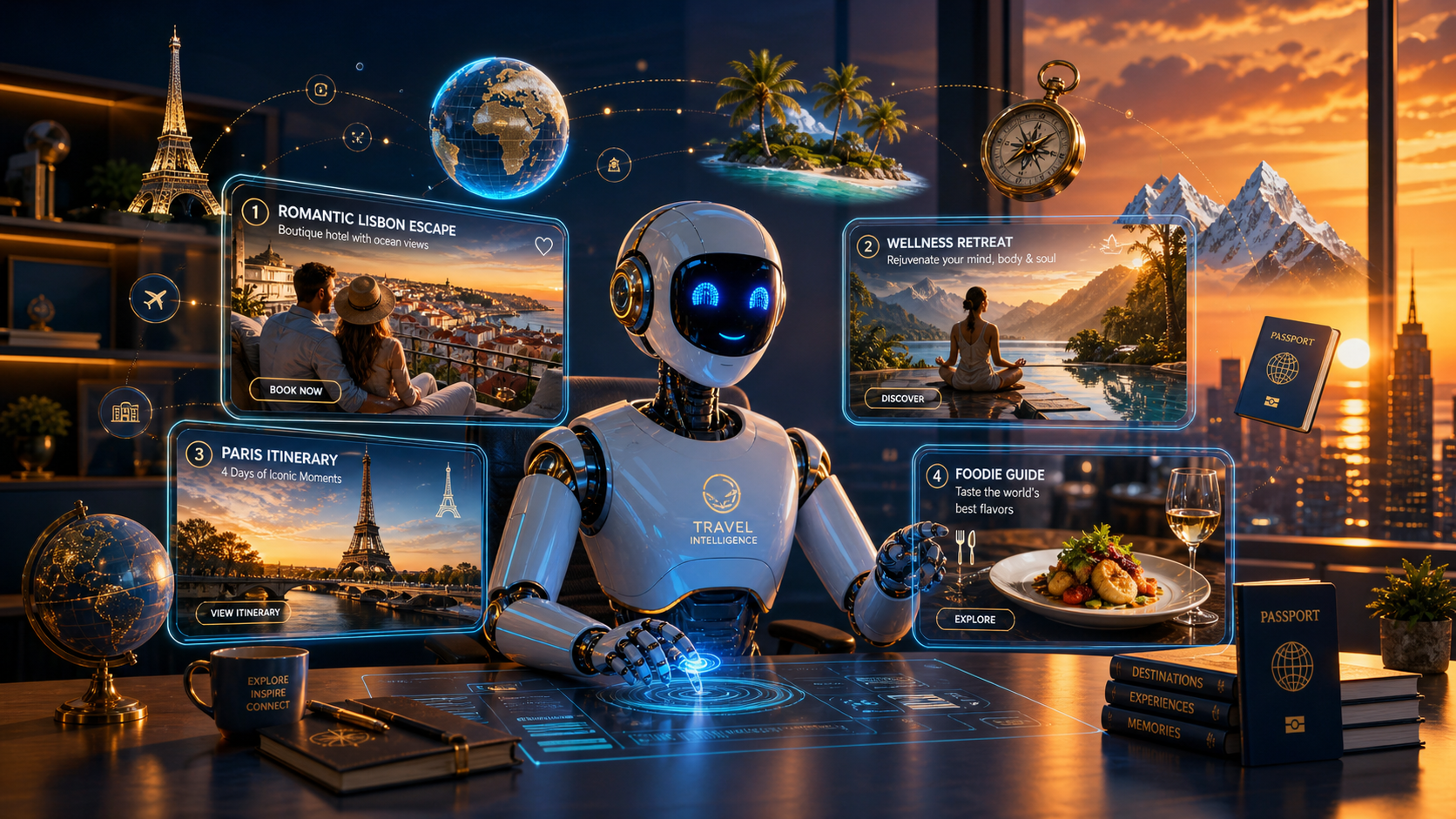
- The brands winning at AI in travel marketing share three habits: clean data foundations, deep content libraries, and a journey-first measurement mindset. Personalization in hospitality marketing only works when you stay on the helpful side of the helpful-versus-creepy line. First-party data and transparent privacy policies do most of that work.
Travel brands cannot afford to keep treating every guest the same. Today’s travelers expect marketing that feels like it was made for them, and the gap between brands using AI to deliver that and brands still blasting generic emails is widening fast. Travelers are not just open to AI in their journey, they are actively seeking it. According to Accor’s 2025 Travel Trends report, 13 percent of British travelers said they would use an “AI-tinerary” in 2025, and searches for “AI in the travel industry” rose by 100 percent over the previous 12 months. (Accor, 2025) On the brand side, McKinsey research shows that personalization marketing can reduce customer acquisition costs by as much as 50 percent, lift revenues by 5 to 15 percent, and increase marketing ROI by 10 to 30 percent. (McKinsey & Company, 2023) For travel brands competing against OTAs, branded chains, and large publishers in every search result, those numbers represent real margin and real survival. In this blog, we will cover how AI in travel marketing is reshaping personalization, what travel marketing automation actually does behind the scenes, and how hotels, agencies, and tour operators can put it to work without losing the human touch their guests came for in the first place.
Smarter travel marketing begins when AI listens before it speaks
Marketing teams in travel are under more pressure than ever before. Email lists are growing, ad costs are rising, and traveler attention is splintering across Google, TikTok, ChatGPT, Instagram, and Reddit. That’s why many travel brands are turning to AI in travel marketing to keep up without burning out their teams.
McKinsey’s research on personalization is unambiguous: 71 percent of consumers now expect companies to deliver personalized interactions, and 76 percent get frustrated when this doesn’t happen. (McKinsey & Company, 2021) For travel brands, where the booking decision can take weeks of research and dozens of touchpoints, getting that experience right is the difference between a direct booking and a guest disappearing into an OTA.
With tools like TypeHero.ai’s travel content marketing solutions, brands can move from generic batch-and-blast campaigns to journeys that adapt in real time. By using AI to read traveler signals, group audiences by actual behavior, and generate content for each segment, travel marketers can deliver experiences that feel personal at every touchpoint.
Travelers are already asking for AI in their journey
Personalization in travel is not a top-down idea pushed by marketers. It’s a bottom-up demand from travelers themselves. Accor’s 2025 Travel Trends report introduced the term “AI-tinerary” to describe AI-powered travel planning tools that build personalized, seamless itineraries through virtual assistants, trip generators, and predictive technology. (Accor, 2025) The fact that a hospitality group as large as Accor coined and surveyed around the term is itself a signal: travelers expect AI to be part of how they plan, book, and experience trips.
The supporting numbers are telling. 13 percent of British travelers said they would use an AI-tinerary in 2025, and searches for “AI in the travel industry” doubled in the previous 12 months. (Accor, 2025) Two specific behaviors are driving this:
- Effortless trip planning. AI automates the work of finding flights, comparing accommodation, and assembling activities based on real preferences. What used to take a planner several hours now takes minutes.
- Real-time adaptability. AI adjusts to flight delays, weather changes, and last-minute preferences during the trip itself, not just before it.
For travel marketers, the takeaway is simple. The traveler arriving on your website has very likely already used AI to research the destination. They expect your marketing to operate at the same level of personalization. AI in travel marketing is no longer just a back-office capability. It’s the standard travelers walk in expecting.
What travelers actually want from personalized marketing
When McKinsey researchers studied what consumers actually want from personalized marketing, they found four consistent asks. (McKinsey & Company, 2023) The findings translate cleanly to travel and hospitality:
- “Give me relevant recommendations I wouldn’t have thought of myself.” Travelers do not want to be reminded of the room type they already viewed five times. They want to be told about the rooftop bar two streets over, the museum exhibit that opens during their stay, or the neighborhood they hadn’t considered.
- “Talk to me when I’m in shopping mode.” Timing matters as much as content. A traveler researching Lisbon at 11 p.m. on a Sunday is in a different mode than the same traveler scrolling LinkedIn on Tuesday morning.
- “Remind me of things I want to know but might not be keeping track of.” Flight prices dropping, suite availability opening up for their target dates, a seasonal event aligning with their planned trip, all of it is welcome when it’s relevant and quietly ignored when it’s not.
- “Know me no matter where I interact with you.” A guest who books direct, follows the brand on Instagram, and reads the email newsletter expects continuity. They should not be re-introduced to the property every time they switch channels.
The fourth point is the hardest for travel brands to deliver because it requires the booking engine, CRM, email tool, ad platform, and CMS to actually share data. Most do not. Closing that gap is usually step one in any serious AI in travel marketing investment.
Why are travel brands struggling with personalization?
Personalization is not a new idea in travel. It has been the goal for over a decade. The real challenge is that most brands have never had the data infrastructure or the content volume to actually pull it off.
Travel marketing automation is essential here. Hotels and agencies can leverage AI to manage repetitive yet important tasks automatically, freeing their human teams to focus on strategy, brand voice, and guest experience. McKinsey calls this the “trigger” model: when customers provide signals about their intentions, marketers should be prepared to respond right away with a relevant message. (McKinsey & Company, 2023) For a hotel, that signal might be a guest searching “anniversary stay,” browsing the spa page twice, or returning to the website after a two-week gap. The trigger is the personalized response that reaches them within hours, not weeks.
People also ask: Can AI really personalize travel content at scale?
Yes, when trained on a brand’s voice, audience data, and booking history. AI can generate, test, and adjust thousands of content variations across email, landing pages, and social platforms simultaneously, all while maintaining a consistent tone. That capability is exactly what AI brings to travel marketing teams who could not previously produce content at this volume.
5 personalization mistakes travel brands still make
Even seasoned marketing teams fall into the same traps when trying to personalize at scale. These mistakes slow growth and waste budget.
- Surface-level personalization. Adding a first name to a subject line is not personalization. It’s window dressing. Audiences see through it almost immediately, and engagement keeps falling.
- Static segmentation. Building rigid audience lists once a year and never updating them. Real traveler behavior shifts month to month, and segmentation needs to shift with it.
- Personalization without enough content. Promising guests tailored experiences but only having one homepage and one email template to draw from. Without a content library, AI has nothing useful to personalize with.
- Automation that feels robotic. McKinsey notes that “too often, automation software spits out messages that customers perceive as spam.” (McKinsey & Company, 2023) The fix is not less automation, it’s smarter triggers tied to actual signals.
- Ignoring AI-driven discovery channels. Many brands still optimize only for Google. Travelers now ask ChatGPT, Gemini, and Perplexity for hotel and itinerary recommendations. Brands not showing up there are quietly missing a growing share of demand.
TypeHero, is AI-powered content marketing system addresses these gaps by giving travel businesses a unified system for content creation, personalization, and AI-search visibility. Specifically, the platform is designed to help hotels, advisors, and tour operators build content libraries that are ready to be personalized rather than scrambling to write one-offs after every campaign.
How personalized travel marketing actually boosts revenue
McKinsey’s data on personalization is clear: it can reduce customer acquisition costs by up to 50 percent, lift revenues by 5 to 15 percent, and increase marketing ROI by 10 to 30 percent. (McKinsey & Company, 2023) For a hotel running on tight margins or an agency competing against OTAs, that lift is significant, especially because it compounds over time as the AI system gets smarter about each returning guest.
A practical example: imagine a couple in Berlin researching a romantic trip to Lisbon for their anniversary. They click a Google ad for a boutique hotel in Alfama. Instead of seeing a generic homepage, the landing page they land on leads with terrace views and a curated walking route through Fado bars, because the AI recognized their search query mentioned anniversary. Two days later, they get an email titled “Three quiet corners of Lisbon most couples miss” rather than a generic discount pop-up. A week later, the homepage hero shows them a king suite with a private terrace, not the standard double they saw the first time. They book.
No human marketer scripted that journey. The AI-driven system did, by quietly responding to signals at every step.
This is what personalization in hospitality marketing looks like when it actually works. It does not feel like marketing. It feels like a hotel that paid attention.
How brands scale personalization: the four Ds
McKinsey’s framework for scaling personalization rests on four pillars, the four Ds. (McKinsey & Company, 2023) Translated into travel marketing, they look like this:
Data. Centralize traveler data so that activity in one channel immediately informs the next. A guest who browses spa packages on the website should not get a generic family-stay email the next morning.
Decision making. Build an integrated engine, often using machine learning, that scores each traveler’s likelihood of booking, upgrading, or returning, and decides which message to send when.
Design. Break content into modular pieces that can be mixed and matched per guest. A single destination guide should be reusable as email copy, paid ad variants, and landing page sections.
Distribution. Coordinate channels so the same traveler does not get conflicting messages from email, retargeting, and on-site personalization at the same time.
The four Ds are not optional. Skipping any one of them is why most personalization programs in travel underperform.
A real-world example outside travel that travel brands can learn from
Sephora is widely regarded as one of the strongest personalization programs in retail, and the lessons translate directly. The beauty retailer connects in-store and online experiences through its mobile app, lets makeup artists log products into each customer’s profile, and offers loyalty members early access to new products and exclusive events. By 2018, members accounted for 80 percent of total transactions, and by 2020 the loyalty program had reached about 25 million members. (McKinsey & Company, 2023)
For travel brands, the takeaway is not to copy Sephora, it’s to recognize the underlying principle: the deepest personalization happens when a brand recognizes returning customers across every channel and rewards them for coming back directly. That’s exactly what direct booking strategies are supposed to do, and what OTAs structurally cannot.
Doing personalization without being creepy
Personalized marketing has a thin line between helpful and unsettling. Travelers, like any customer, can feel that line cross when an ad is too specific or a message arrives at an uncomfortable moment.
McKinsey’s research found that 85 percent of customers say knowing a company’s data privacy policies is important before making a purchase. (McKinsey & Company, 2023) For travel brands, two simple rules help:
- Use first-party data first. Information guests share with you directly through bookings, surveys, and on-site behavior is more reliable, more useful, and more trusted than third-party data scraped from elsewhere.
- Be transparent about what you do with it. A short, plain-English privacy policy on your booking page does more for trust than the longest legal document a lawyer can produce.
7 useful ways travel brands can use AI for personalization
Personalization does not have to be complicated. There are several practical ways travel brands can use AI today:
- Define your brand voice once. Train AI on your tone of voice, key messages, and editorial guidelines so every personalized piece still sounds like you.
- Build segment-specific landing pages. Use AI to generate variations for couples, families, foodies, wellness travelers, and business stays so paid traffic always lands somewhere relevant.
- Automate dynamic email journeys. Trigger emails based on actual behavior, like browsing the spa page twice, rather than fixed schedules.
- Personalize on-site experiences. Show different homepage heroes, recommended room types, and featured experiences based on referral source, search query, and prior visits.
- Generate destination and neighborhood guides at scale. Cover the long-tail content travelers actually search for when planning, not just the headline pages.
- Optimize for AI-driven discovery. Structure content for citation in ChatGPT, Gemini, and Perplexity, not only for Google ranking.
- Repurpose existing content intelligently. Turn one strong destination guide into newsletter copy, social posts, paid ad variants, and chatbot scripts automatically.
These steps help travel brands deliver personalized travel marketing that feels human, not mechanical, while saving hours of manual content production every week.
Insider insight: what high-growth travel brands do differently
McKinsey’s research consistently finds that companies with faster growth rates derive 40 percent more of their revenue from personalization than their slower-growing counterparts. (McKinsey & Company, 2023) The brands pulling ahead are not the ones with the biggest marketing teams. They are the ones with the cleanest data foundation and the largest content libraries to personalize from.
Three patterns show up consistently:
- They treat content as infrastructure, not output. Every destination guide, neighborhood page, and lifestyle article becomes raw material AI can pull from later. They invest in the library before they invest in personalization tools.
- They unify their data early. Booking engine, CRM, email platform, and CMS talk to each other. AI is only as smart as the data it can see.
- They measure journeys, not campaigns. Instead of tracking the open rate of one email, they track how a traveler moves from first AI-generated recommendation through booking, stay, and return.
Key takeaways: making AI work for travel marketing
- AI in travel marketing is no longer optional. 71 percent of consumers expect personalized interactions, and 76 percent get frustrated when those expectations are not met. (McKinsey & Company, 2021)
- Travelers themselves are demanding it. 13 percent of British travelers said they would use an AI-tinerary in 2025, and searches for AI in the travel industry doubled in 12 months. (Accor, 2025)
- Personalization can reduce customer acquisition costs by up to 50 percent, lift revenues by 5 to 15 percent, and improve marketing ROI by 10 to 30 percent. (McKinsey & Company, 2023)
- Real personalization needs three things: clean data, a deep content library, and AI to connect the two.
- The four Ds, Data, Decision making, Design, and Distribution, are the framework for scaling personalization without it falling apart.
- Travel marketing automation is most powerful when paired with strategic content investment, not when used to send the same generic message faster.
- Personalization in hospitality marketing pays back in three measurable ways: lower acquisition costs, higher revenue per booking, and stronger repeat rates.
